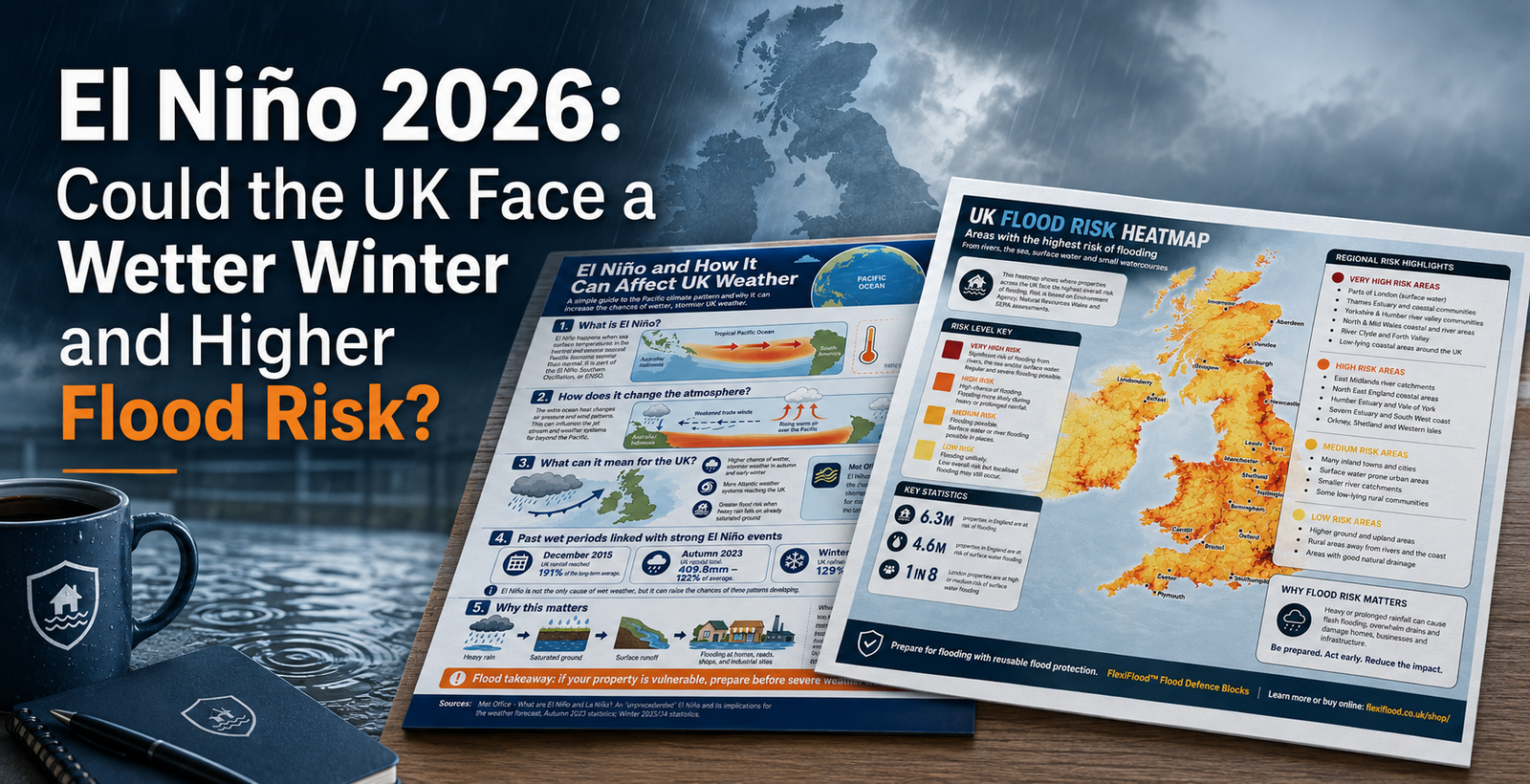
The UK could be facing a wetter and stormier start to winter as a strong El Niño develops in the Pacific Ocean.
The Met Office says the developing 2026 El Niño is expected to increase the chances of wetter and stormier conditions across north-west Europe, including the UK, during autumn and early winter.
That does not mean flooding is guaranteed. UK weather is affected by many different factors. However, periods of prolonged or heavy rainfall can quickly increase the risk of surface water, river and drainage flooding.
For homeowners, businesses, industrial sites, facilities managers and local authorities, this is a good time to review flood preparations rather than waiting for a flood warning to be issued.
If your property is already vulnerable to flooding, preparing early could make a significant difference.
Shop FlexiFlood™ Flood Defence Blocks
What is El Niño?
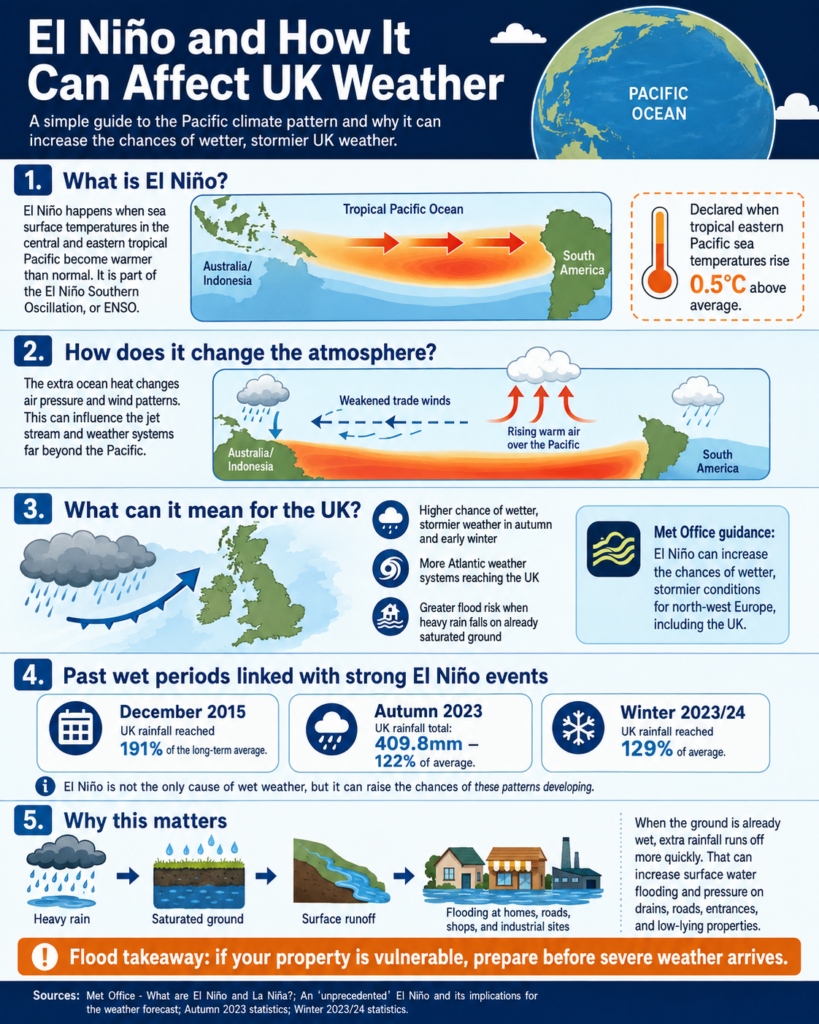
El Niño is a naturally occurring climate pattern involving unusually warm water in the tropical Pacific Ocean.
Although this happens thousands of miles from Britain, the extra heat affects atmospheric circulation and can alter weather patterns around the world.
One of the ways this can affect the UK is by influencing the jet stream and the route taken by Atlantic weather systems.
The Met Office explains that El Niño is part of the El Niño Southern Oscillation, or ENSO, which is one of the most important sources of year-to-year variation in the global climate.
The effect on Britain is less direct than in countries around the Pacific, but El Niño can increase the likelihood of milder, wetter and windier conditions during autumn and the first part of winter.
Where did the name El Niño originate?
The name came from Peruvian and Ecuadorian fishermen, who noticed that unusually warm Pacific Ocean waters sometimes appeared along the west coast of South America around Christmas. Because of the timing, they called the warm current “El Niño de Navidad”, referring to the Christ Child.
Over time, scientists adopted El Niño as the name for the much larger climate phenomenon in which surface waters across the central and eastern tropical Pacific become unusually warm.
Its opposite, La Niña, literally means “The Little Girl” and describes the cooler-than-normal phase of the same climate system.
What could El Niño mean for UK weather in 2026?
El Niño conditions were officially declared during June 2026.
At the time, the Met Office reported that forecasts suggested the event could become very strong, with sea-surface temperature anomalies potentially exceeding 2°C above normal in parts of the central and eastern tropical Pacific.
As the event has developed, the Met Office has said:
"We expect the influence of El Niño to start to increase the chances of wetter, stormier conditions for NW Europe, including the UK, in the coming autumn and early winter."
Source: Met Office - An 'unprecedented' El Niño and its implications for the weather forecast.
This is important for flood planning because it is often repeated rainfall rather than one exceptionally wet day that creates the biggest problems.
Once soil becomes saturated, additional rain runs off more quickly. Rivers can rise faster, drainage systems have less capacity and water can begin flowing across roads, car parks and paved areas.
Does El Niño always make Britain wetter?
No.
El Niño does not automatically mean that Britain will have a wet winter.
The UK's weather is affected by the Atlantic Ocean, jet stream, North Atlantic Oscillation, atmospheric pressure patterns and several other global climate drivers.
However, the Met Office says El Niño generally increases the likelihood of a windy and mild start to winter, with wetter and more unsettled Atlantic weather potentially becoming more likely.
Seasonal forecasts therefore deal in probabilities rather than predicting the exact rainfall that will fall on a particular town several months in advance.
For flood planning, that distinction is important. There may not be certainty, but there is enough increased risk to make preparation sensible.
What happened during previous strong El Niño events?
Past El Niño events provide useful examples of how wet UK autumn and winter periods can become.
El Niño should not be considered the sole cause of these events. Several weather and climate factors were involved. However, there have been some notably wet periods during recent strong El Niño episodes.
The 2015-2016 El Niño
The 2015-16 El Niño was one of the strongest on record and coincided with an exceptionally wet start to winter in Britain.
Met Office figures show UK rainfall compared with the 1981-2010 average reached:
- November 2015: 145% of average rainfall
- December 2015: 191% of average rainfall
- January 2016: 152% of average rainfall
- February 2016: 129% of average rainfall
December 2015 became the wettest calendar month in the UK rainfall series at that time.
Severe flooding affected Cumbria and southern Scotland on 5-6 December, followed by major flooding across parts of Lancashire and Yorkshire later that month.
The complete winter of December 2015 to February 2016 went on to become the second wettest UK winter on record in the Met Office series dating back to 1910.
Sources: Met Office Seasonal Forecasting Report and State of the UK Climate 2016.
The 2023-2024 El Niño
A strong El Niño also developed during 2023.
That autumn was considerably wetter than normal in many parts of Britain.
The UK received 409.8mm of rain during autumn 2023, equivalent to 122% of the 1991-2020 average.
England received 135% of its average autumn rainfall, while some areas of eastern Scotland, north-east England, eastern England and southern England received more than 150% of average rainfall.
The wet conditions continued into winter.
During winter 2023-24:
- UK rainfall was 129% of average
- England received 149% of average
- Wales received 139% of average
- The UK recorded 445.8mm of winter rainfall
- It became the eighth wettest UK winter on record
Again, El Niño was not solely responsible. However, these figures demonstrate what wetter-than-average seasons can look like during periods when a strong El Niño is part of the global climate pattern.
Sources: Met Office Autumn 2023 statistics and Met Office Winter 2023/24 statistics.
Why heavier rainfall means greater flood risk
Flooding does not only happen when rivers burst their banks.
One of Britain's growing problems is surface water flooding.
This happens when rainfall falls faster than it can drain away. Water begins collecting on roads, car parks, pavements and other hard surfaces before flowing towards lower ground.
Commercial buildings, warehouses, shopping centres, factories and homes can therefore flood even when they are some distance from a major river.
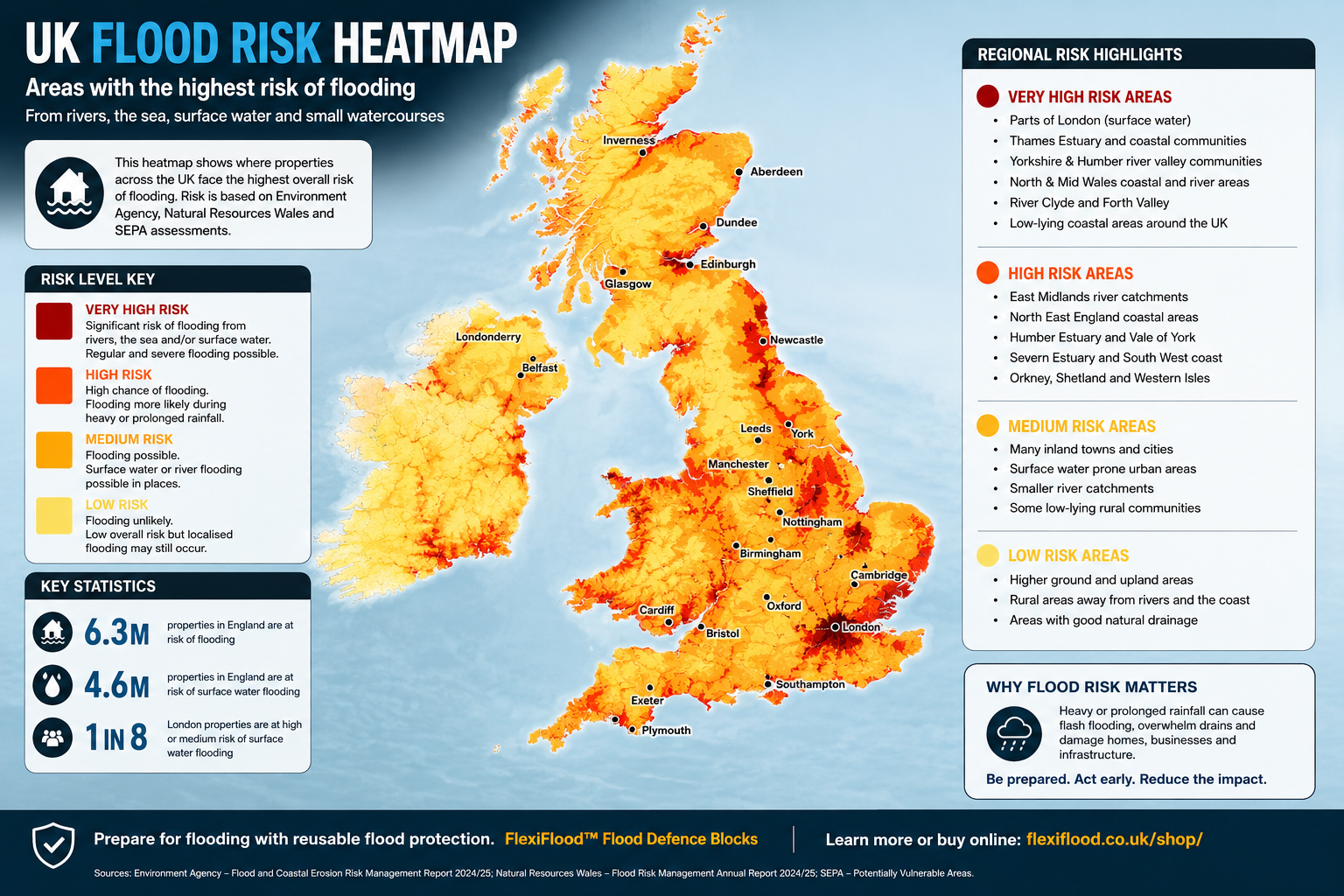
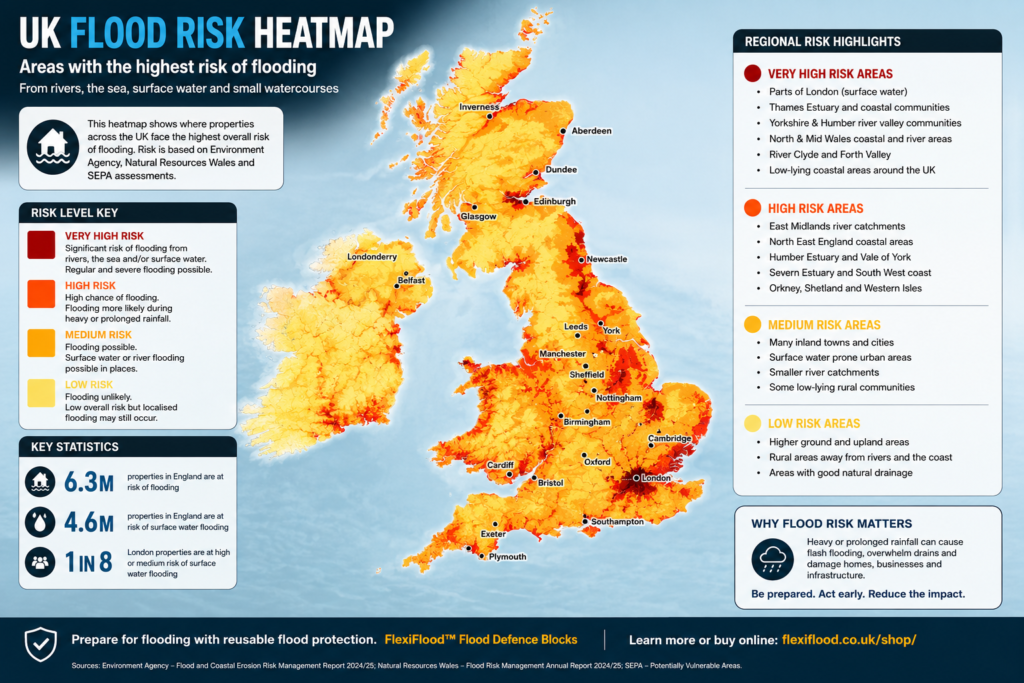
The Environment Agency's latest National Flood Risk Assessment estimates that around 6.3 million properties in England are in areas at risk of flooding from rivers, the sea, surface water or a combination of these sources.
Around 4.6 million properties are in areas at risk from surface water flooding.
Source: Environment Agency Flood and Coastal Erosion Risk Management Report.
Where are the most flooded areas in Britain?
There is no single official league table showing Britain's "most flooded" towns because flood risk varies depending on whether the threat comes from rivers, surface water, coastal flooding or smaller watercourses.
However, official flood-risk assessments identify several regions and communities where the risk is particularly significant.
Here's a .gov website to check for flood risk areas: https://flood-map-for-planning.service.gov.uk/
Yorkshire and the Humber
Yorkshire has a long history of river and surface water flooding, particularly within steep river valleys such as the Calder Valley.
The Environment Agency estimates that around 115,200 properties in Yorkshire and the Humber are in areas at high or medium risk from river and sea flooding.
This represents around 3.6% of all properties in the region.
Communities including Hebden Bridge, Mytholmroyd, York, Sheffield and parts of Leeds have all experienced significant flooding in the past.
London
London has a particularly significant surface water problem because of the amount of roads, roofs, paving and other impermeable surfaces.
The Environment Agency estimates that approximately 543,500 properties in London are in areas at high or medium risk of surface water flooding.
That is around 12.6% of properties in London, roughly one in eight.
This is why surface water management can be particularly important for shopping centres, council buildings, housing developments, transport infrastructure and commercial premises.
East Midlands and South East England
The Environment Agency also identifies substantial river and sea flood exposure in these regions.
Approximately 127,500 properties in the East Midlands and 113,900 properties in South East England are in areas considered to have a high or medium risk of flooding from rivers and the sea.
Wales
Natural Resources Wales estimates that approximately 275,000 properties in Wales are at risk of flooding.
That is roughly one in seven Welsh properties.
The current assessment includes approximately:
- 106,000 properties and services potentially affected by river flooding
- 92,000 potentially affected by sea flooding
- 144,000 potentially affected by surface water and small watercourses
Some properties appear in more than one category.
Source: Natural Resources Wales Flood Risk Management Annual Report.
Scotland
SEPA has identified hundreds of Potentially Vulnerable Areas across Scotland where flood risk is considered sufficiently significant to require focused flood-risk planning.
Previous national assessments have estimated that around 284,000 homes, businesses and services in Scotland are at risk of flooding.
Areas identified within Scotland's flood-risk planning include communities around Glasgow and the Clyde, Edinburgh, the Forth, Perth and the Tay, Dumfries and Galloway, the Scottish Borders, Moray and parts of the Highlands.
Source: Scottish Environment Protection Agency - Potentially Vulnerable Areas.
Flood protection should be prepared before the warning arrives
One of the biggest problems with emergency flood protection is timing.
Traditional sandbags may need to be sourced, transported, filled and moved into place after a warning has already been issued.
They can also become contaminated by floodwater and may require specialist disposal afterwards.
For organisations responsible for buildings, infrastructure or public spaces, having a reusable flood response system already stored on site can make emergency planning considerably easier.
FlexiFlood™: a reusable alternative to sandbags
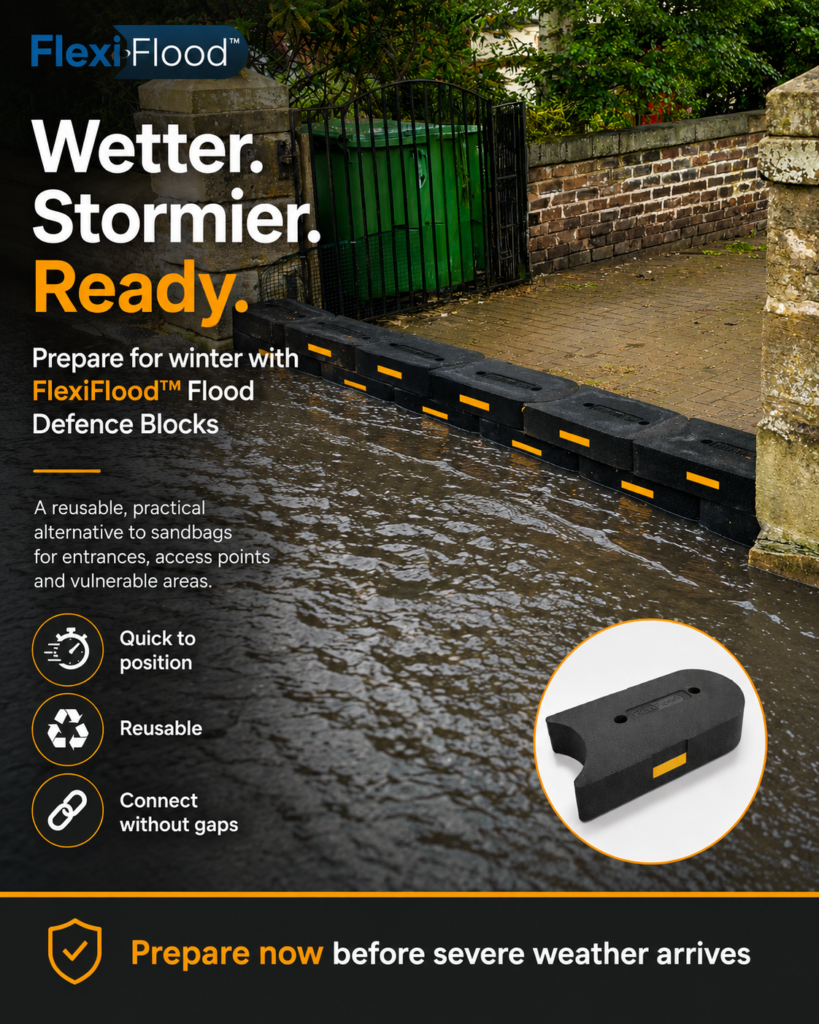
FlexiFlood™ Flood Defence Blocks provide a reusable and more sustainable alternative to traditional sandbags.
The blocks are designed to be stored until required and then quickly positioned when heavy rainfall or flooding threatens.
Benefits include:
- Quick deployment - blocks can be lifted and placed into position without filling sandbags.
- Flexible water control - create straight or shaped barriers to slow, block or redirect water.
- Reusable - clean the blocks after use and return them to storage.
- Easy connection - blocks fit together to create a continuous flood defence line.
- Reduced waste - avoids repeatedly purchasing and disposing of traditional sandbags.
- Reflective strips - improve visibility when blocks are deployed in poor weather or low-light conditions.
They can be used around entrances, loading bays, warehouses, shops, council facilities, residential properties, access roads and other areas vulnerable to surface water.
Buy FlexiFlood™ Online
FlexiFlood in action: Hebden Bridge
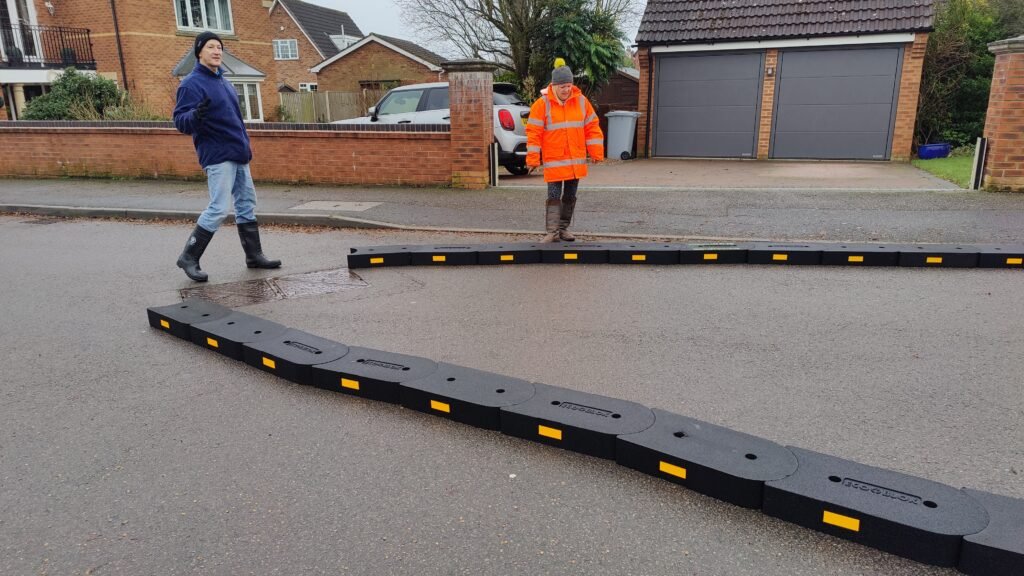
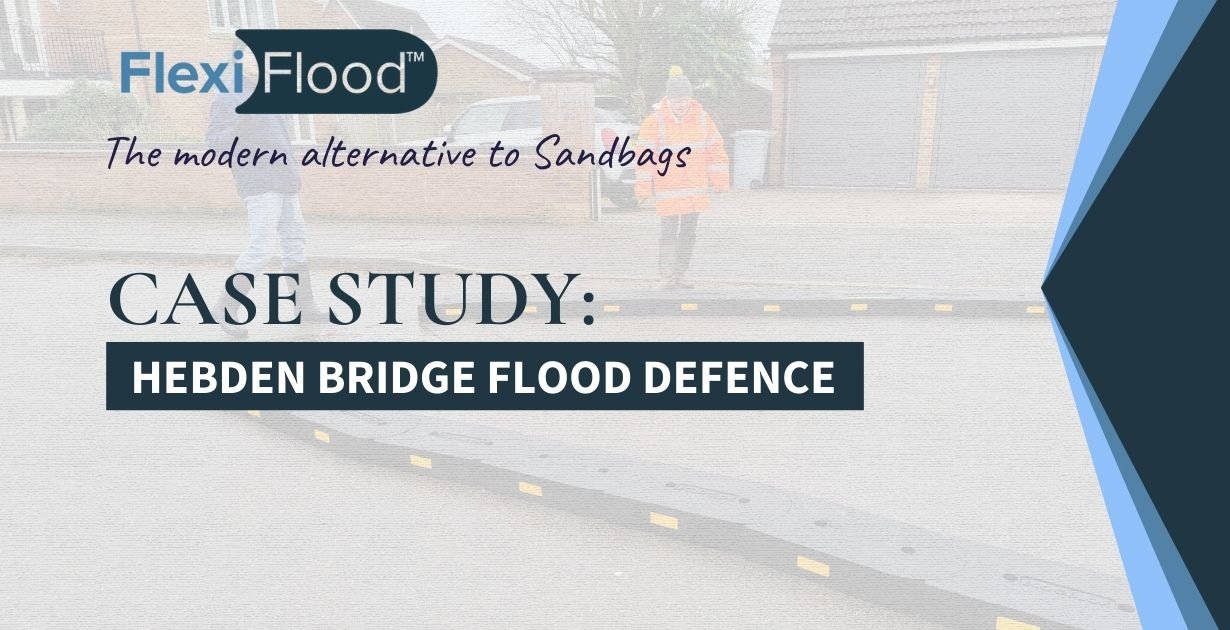
Hebden Bridge in West Yorkshire is particularly vulnerable to rapid surface water flooding because of its position within the steep-sided Calder Valley.
During intense rainfall, water can run rapidly down hillside roads towards Market Street. The flow can become so fast that it passes over drainage points rather than entering them.
FlexiFlood blocks have been supplied to the Hebden Bridge Flood Wardens.
The volunteers use the blocks to create shaped catchments around drains, helping to slow and direct water towards the drainage system instead of allowing it to continue towards vulnerable businesses and properties.
Once the flood risk has passed, the blocks can be cleaned and returned to storage ready for the next incident.
Hebden Bridge Flood Warden Andrew Entwistle described the blocks as:
"One of our most useful and adaptable tools in responding to flooding."
Read the full Hebden Bridge flood defence case study →
FlexiFlood in action: Stratford Centre, London
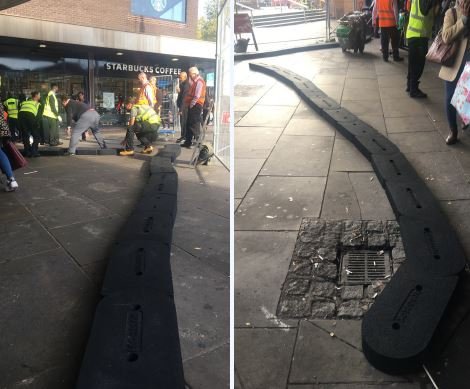
Stratford Centre is one of London's busiest shopping destinations, with around 400,000 visitors each week.
The centre's location at the bottom of a slope means fast-moving surface water can travel towards its entrances.
During a major flood in July 2018, water reached approximately 4 to 6 inches deep across large sections of the centre.
The shopping centre was closed for two days and reported costs had already reached around £140,000, before all losses had been calculated.
FlexiFlood blocks were subsequently selected as part of the centre's flood contingency planning.
The blocks can be quickly deployed and arranged to guide water towards drainage points while still allowing pedestrian access to the shopping centre.
Staff have also carried out practice deployments so that employees know how to position the flood defence when required.
Read the full Stratford Centre flood defence case study →
Who should be preparing for flooding now?
Flood preparedness is not only an issue for homeowners who live beside rivers.
Organisations responsible for any property where surface water could enter through doors, loading bays, car parks or low-level access points should review their plans.
This includes:
- Homeowners and landlords
- Housing associations
- Local authorities and councils
- Schools and colleges
- Hospitals and healthcare premises
- Factories and industrial estates
- Warehouses and distribution centres
- Retail parks and shopping centres
- Hotels and leisure facilities
- Facilities management companies
- Utility and infrastructure operators
- Commercial property owners
The important question is not simply whether your property has flooded before.
Ask what would happen if unusually heavy rainfall overwhelmed the drains outside your property tomorrow.
Prepare now, rather than during the flood
No seasonal weather forecast can tell us exactly where flooding will happen months in advance.
What we do know is that the current strong El Niño is increasing the likelihood of wetter and stormier conditions affecting the UK during autumn and early winter.
We also know that millions of British properties are already located in areas exposed to river, coastal or surface water flooding.
Flood preparation is therefore best treated in the same way as other risk management.
Prepare while conditions are calm.
Identify where water is likely to enter. Decide where temporary defences would be positioned. Make sure staff know what to do. Store the equipment somewhere accessible.
Then, when severe weather is forecast, your flood defence can be deployed quickly rather than sourced at the last minute.
Shop FlexiFlood™ Flood Defence Blocks
Frequently Asked Questions
Will El Niño make the UK wetter in 2026?
The Met Office says the developing 2026 El Niño is expected to increase the chances of wetter and stormier conditions across north-west Europe, including the UK, during autumn and early winter. This does not guarantee that every part of Britain will experience above-average rainfall.
Does El Niño cause flooding in the UK?
El Niño does not directly cause every flood. It can influence global atmospheric circulation and increase the probability of weather patterns associated with wetter and stormier UK conditions. Flooding then depends on rainfall intensity, soil conditions, river levels, drainage capacity, tides and local geography.
Was the 2015-16 El Niño winter wet in Britain?
Yes. During the strong 2015-16 El Niño, UK rainfall reached 145% of average in November 2015, 191% in December, 152% in January 2016 and 129% in February. Winter 2015-16 became the UK's second wettest winter on record at the time.
Which parts of Britain are most at risk of flooding?
Flood risk varies by type. Yorkshire and the Humber has significant river flood exposure, while London has particularly high surface water flood risk. Around one in eight London properties are in areas at high or medium surface water flood risk. Wales has approximately 275,000 properties at risk of flooding, while SEPA identifies numerous Potentially Vulnerable Areas across Scotland.
How many properties in England are at risk of flooding?
The Environment Agency estimates that around 6.3 million properties in England are in areas at risk from rivers, the sea, surface water or a combination of these sources. Around 4.6 million are in areas at risk of surface water flooding.
What is surface water flooding?
Surface water flooding happens when heavy rainfall cannot drain away quickly enough. Water can then collect on roads and paved areas or flow towards lower ground, buildings and entrances. It can happen even in locations that are not close to a river.
Are FlexiFlood blocks reusable?
Yes. FlexiFlood Flood Defence Blocks are designed to be cleaned after deployment and stored ready for future flood events, providing a reusable alternative to traditional sandbags.
Where can I buy FlexiFlood flood defence blocks?
FlexiFlood Flood Defence Blocks can be purchased online directly from the FlexiFlood online shop.
Sources and further reading